
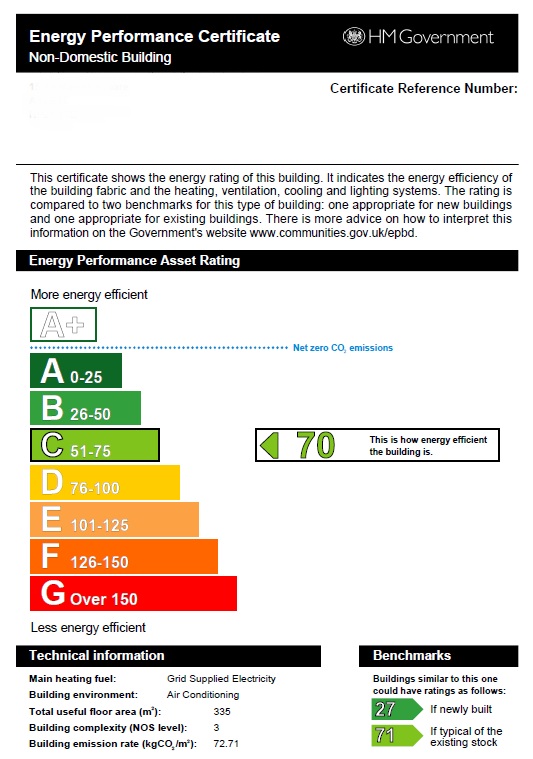
AHS Property Solutions is providing Commercial EPCs for over 15 years. We offer reliable and accurate services at fixed price with no hidden charges.
EPC (Energy Performance Certificate) is required to sell or let your commercial property. All EPCs are valid for 10 years. You can place your order online by completing our simple order form or call us on 07419828817 and we will be happy to help. You can pay via cash to the assessor, bank transfer or via Paypal.
| Sq ft | Sq meter | Price | Order |
|---|---|---|---|
|
0-540 ft2 |
0-50 m2 |
£130 |
|
|
541-1070 ft2 |
51-100 m2 |
£180 |
|
|
1071-1610 ft2 |
101-150 m2 |
£230 |
|
|
1611-2150 ft2 |
151-200 m2 |
£260 |
|
|
2160-3230 ft2 |
201-300 m2 |
£290 |
|
|
3240-4310 ft2 |
301-400 m2 |
£380 |
|
|
4320-5380 ft2 |
401-500m2 |
£440 |
|
|
5390-7530 ft2 |
501-700 m2 |
£550 |
|
|
7530 +ft2 |
700 + m2 |
Hello there! We understand you might have a few questions about our services and how we can help you with your property compliance needs. To make things easy, we’ve compiled a list of frequently asked questions below.
We hope this section gives you the clarity you’re looking for. If anything’s still unclear, or you just want to say hi, feel free to contact us — we’re always here to help
An EICR (Electrical Installation Condition Report) is also often called a Landlord Electrical Certificate. It involves a survey to create a report into the condition of the wiring of a property – fuse board, sockets, switches and lighting. The Report outlines any aspects of the installation which require attention, and shows their priority as below:
C1– Danger present. Risk of injury. Immediate remedial action required.
C2– Potentially dangerous – urgent remedial action required.
C3 – Improvement recommended.
If any Code C1 or C2 faults are present, the overall rating will be ‘unsatisfactory’ meaning there are immediate risks to both the property and tenants. These should obviously be rectified as soon as possible to prevent injury, or legal repercussions if you intend renting the property.
The inspection will find out if: any electrical installations are overloaded there are any potential electric shock risks and fire hazards there is any defective electrical work there is a lack of earthing or bonding – these are 2 ways of preventing electrical shocks that are built into electrical installations.
A landlord must ensure that all electrical safety standards are met. The standards that should be met are set out in British Standard 7671, also known as the 18th edition of the Wiring Regulations.
The regulations refer to “residential premises”, which are premises all or part of which comprise a dwelling.Excluded tenancies are: shared accommodation with the landlord or the landlord’s family
long leases (including shared ownership leases) or tenancies that grant a right of occupation of seven years or more
student halls of residence
hostels and refuges
care homes, hospitals and hospices
other accommodation relating to healthcare provisions
mobile homes, caravans and boats
It depends on the size of the property but between 2-4 hours are usually enough to complete the survey.
Our electrician will need good access to sockets, switches and the distribution or ‘fuse’ board. Power will need to be turned off.
If the report or record shows that remedial work or further investigation is required, as set out above, landlords must complete this work within 28 days or any shorter period if specified as necessary in the report/record. Landlords must then provide the report/record and written confirmation that the work has been carried out to their tenant and to the local council within 28 days. Acceptable forms of written confirmation include a satisfactory EICR, an Electrical Installation Certificate (EIC), a Minor Electrical Installation Works Certificate (MEIWC) or other appropriate electrical certification.
An EICR (Electrical Installation Condition Report) frequency depends on property type: landlords must do it every 5 years , while homeowners are recommended to do it every 10 years.
No. If inspection and testing of electrical installation in the premises was carried out less than 5 years ago and the report does not require further investigative or remedial work; a new inspection and testing is not required; the landlord must supply a copy of the most recent report to the new tenant. There is no requirement to do a further inspection and testing before re-letting the premises.
However, it is recommended that landlords carry out at least a visual inspection prior to a new tenancy commencing, to confirm that the premises remain electrically safe and that no damage or deterioration has occurred since the last report/record.




WhatsApp us